


An Export Declaration is an official document required by customs authorities to provide details about goods being shipped out of a country. It ensures compliance with trade regulations, helps governments monitor exports, and allows customs to collect trade statistics.
In many countries, the export declaration must be filed electronically before goods are loaded and shipped.

Customs Compliance
Confirms that exported goods comply with export control laws.
Ensures restricted or prohibited items are not illegally shipped.
Statistical Reporting
Governments use data from export declarations to track trade volumes and trends.
Risk and Security Screening
Authorities assess shipments for national security and anti-smuggling measures.
Proof of Export
Serves as documentation for VAT/GST zero-rating in some jurisdictions.
Exporter and consignee details
Description of goods (with HS code)
Quantity and value of goods
Country of origin and destination
Mode of transport (sea, air, road, rail)
Incoterms used (e.g., FOB, CIF)
License or permit numbers (if required)
United States: The equivalent is the Electronic Export Information (EEI), filed via the Automated Export System (AES) for shipments valued over $2,500 or requiring export licenses.
European Union: Export declarations are filed through the Automated Export System (AES), linked to the customs IT platform.
China: Export declarations must be submitted to China Customs before cargo is loaded, including accurate HS codes and export invoices.
Delays in cargo clearance
Fines or penalties
Confiscation of goods in severe cases
Loss of VAT/GST exemptions for exporters
In summary: An Export Declaration is a mandatory filing that provides customs authorities with detailed information about outbound shipments. For companies importing from China or exporting globally, ensuring accurate and timely export declarations is essential to avoid delays, penalties, and compliance risks.
 Door-to-Door SolutionsMarch 27, 2025Door-to-Door Cargo Solutions: From Chinese Factories to Your Warehouse in 7-28 Days"Tired of managing multiple vendors for shipping, customs, and last-mile delivery? Our turnkey door-to-door serv...view
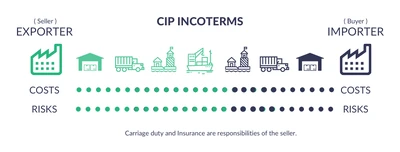 Understanding the CIP Incoterm: Carriage and Insurance Paid toMay 30, 2025The CIP (Carriage and Insurance Paid To) Incoterm is one of the 11 internationally recognized trade terms defined by the International Chamber of Commerce (ICC). It outlines the responsibilities of bu...view
 How a Misprinted Invoice Made Me Rethink China-UK Shipping (And Saved My Business £27k)April 7, 2025Bristol importer spills the tea on cutting logistics chaos - from customs meltdowns to courier cons. CUCFreight's unorthodox hacks inside.view
 Air Freight vs Sea Freight: Choosing the Right Shipping MethodApril 20, 2024In the realm of logistics, the choice between air freight and sea freight can significantly impact the efficiency and cost-effectiveness of transporting goods. Understanding the differences between th...view
 English
  português
  Call us on:
  Email Us:
  International Mayors Exchange Center, No. 55 Shizhou Middle Rd, Nanshan District, Shenzhen Guangdong China
