


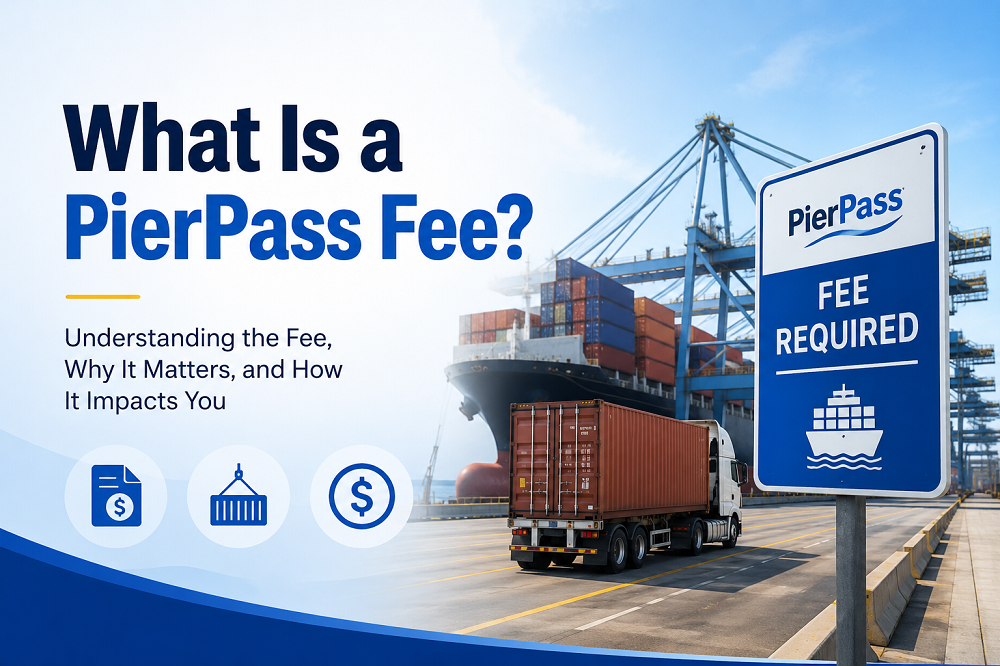
A PierPass Fee, also known as the Traffic Mitigation Fee (TMF), is a port-related surcharge applied to cargo containers moving through the Ports of Los Angeles and Long Beach in the United States. The fee was introduced to reduce daytime congestion at marine terminals and improve cargo flow efficiency.
For importers and shippers moving goods from China to the USA, especially through the U.S. West Coast, the PierPass Fee is a common logistics charge that may appear on freight invoices.
The Ports of Los Angeles and Long Beach are among the busiest container ports in North America. As cargo volumes increased, severe truck congestion, long terminal wait times, and environmental concerns became major operational challenges.
To address these issues, the PierPass program was created to:
Encourage cargo pickup during off-peak hours
Reduce daytime traffic congestion
Improve terminal efficiency
Lower emissions from idling trucks
Speed up container movement through the port
The system helps distribute truck traffic more evenly throughout the day and night.
The PierPass Fee mainly applies to containers handled at:
Port of Los Angeles
Port of Long Beach
These two ports handle a significant percentage of imports from Asia, especially shipments from China.
If your cargo enters the United States through other ports such as:
Port of New York/New Jersey
Port of Savannah
Port of Houston
Port of Seattle
you generally will not see a PierPass Fee, although other terminal or congestion-related surcharges may apply.
In most cases, the PierPass Fee is ultimately paid by:
Importers
Cargo owners
Consignees
The fee is usually collected by:
Freight forwarders
Customs brokers
Shipping agents
NVOCC companies
It may appear on invoices under different names such as:
PierPass
TMF
Traffic Mitigation Fee
Port Congestion Fee
The fee is generally charged per container and may vary depending on:
Container size
Port policy updates
Market conditions
Terminal operations
Typical container types include:
20GP containers
40GP containers
40HQ containers
The charge is usually higher for 40-foot containers than for 20-foot containers.
Because the fee structure may change periodically, importers should confirm current rates with their freight forwarder before shipment.
For Full Container Load (FCL) shipments, the PierPass Fee is commonly charged directly per container.
For Less than Container Load (LCL) shipments, the fee may be divided among multiple cargo owners based on:
Cargo volume
Weight
Consolidation arrangement
In many cases, the forwarder includes the fee within destination charges.
No. The PierPass Fee and Terminal Handling Charges (THC) are different logistics costs.
| Charge Type | Purpose |
PierPass Fee | Reduces port congestion and supports off-peak operations |
THC | Covers physical container handling at terminals |
Both charges may appear separately on destination invoices.
Although the PierPass Fee itself is generally mandatory for affected shipments, importers can reduce overall logistics costs and delays by:
Booking shipments early during peak seasons
Working with experienced freight forwarders
Preparing customs documents in advance
Avoiding long container dwell times
Choosing suitable arrival ports based on delivery location
Efficient cargo planning helps minimize storage fees, demurrage, and port congestion risks.
Understanding the PierPass Fee helps importers:
Better estimate landed costs
Avoid unexpected destination charges
Understand U.S. port operations
Improve supply chain budgeting
For businesses importing from China to the United States, especially through West Coast ports, PierPass is a standard part of international freight logistics.
Yes. If your shipment moves through terminals participating in the PierPass program, the fee is generally mandatory.
The fee mainly affects import cargo, though specific terminal policies may vary.
Yes. Rates may be adjusted periodically based on port operations and industry conditions.
Usually, the fee is collected through freight forwarders, NVOCCs, or terminal-related billing parties rather than directly by ocean carriers.
No. PierPass is primarily associated with the Ports of Los Angeles and Long Beach.
Because it affects total shipping costs, cargo planning, and supply chain budgeting for U.S. imports.
 What Is a Consignor and Consignee?June 26, 2026Consignor and consignee are two of the most important parties in international shipping. The consignor is the person or company that sends the goods, while the consignee is the person or company that ...view
 Shipping Medical Supplies from China: Compliance and Safety TipsJanuary 24, 2025Importing medical supplies from China to the USA can be a highly rewarding yet complex process. The demand for cost-effective, high-quality medical products has skyrocketed in recent years, making Chi...view
 Raw Takeaways from Canton Fair 2025:How Global Buyers Can Beat Tariffs & Tap TrendsApril 28, 2025Navigating the 137th Canton Fair: Insights for Global Importers Amid U.S. Tariff Hikesview
 Shipping from China to ItalyJuly 1, 2025When it comes to international freight from Asia to Southern Europe, China to Italy is a vital trade route—particularly for importers in sectors like fashion, furniture, electronics, and industrial c...view
 English
  português
  Call us on:
  Email Us:
  International Mayors Exchange Center, No. 55 Shizhou Middle Rd, Nanshan District, Shenzhen Guangdong China
