


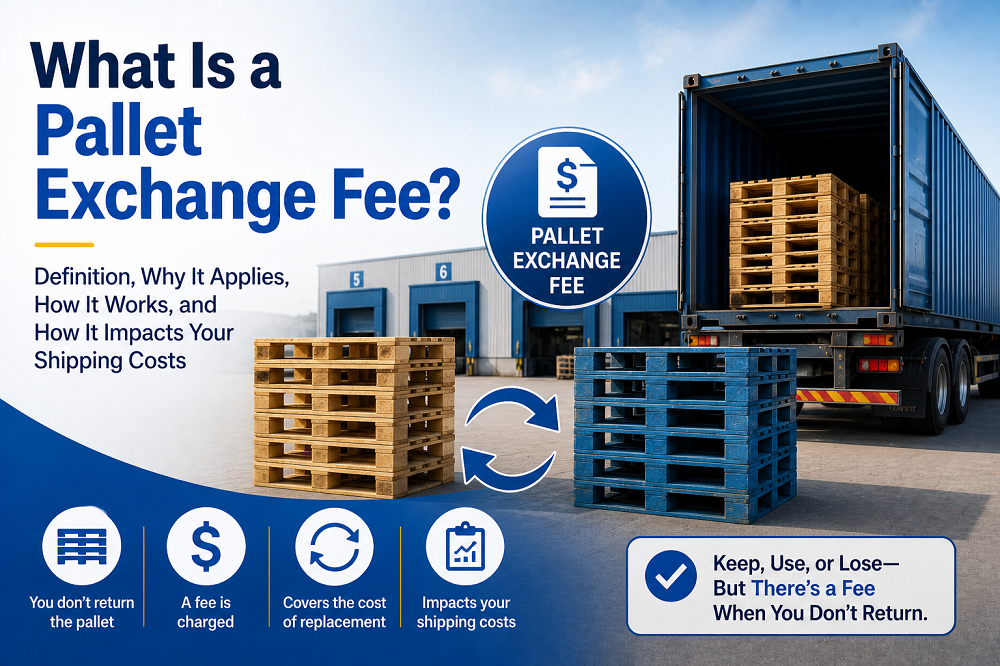
A Pallet Exchange Fee is a logistics charge applied when shipping pallets are not returned, exchanged, or transferred according to an agreed pallet exchange program between shippers, carriers, warehouses, or consignees.
In freight transportation and warehousing, pallets are reusable assets used to move and store cargo safely. When pallets are not returned properly during delivery, the responsible party may be charged a pallet exchange fee to cover replacement or recovery costs.
This fee is common in:
Trucking and LTL shipping
Warehouse distribution
Retail logistics
FMCG supply chains
Beverage and food logistics
Pallet pooling systems
Pallet exchange refers to the process where the receiver returns an equal number of empty pallets to the delivery driver at the time of delivery.
For example:
A truck delivers 20 loaded pallets
The consignee returns 20 empty pallets of the same type
No additional pallet fee is charged
If the receiver cannot return the required pallets, a pallet exchange fee may apply.
Pallets have real operational and material costs. Logistics companies charge pallet exchange fees to:
Recover pallet replacement expenses
Maintain pallet inventory levels
Prevent pallet loss
Reduce supply chain disruptions
Encourage proper pallet management
Without pallet return systems, carriers and suppliers could face significant pallet shortages and increased logistics costs.
The fee may apply when:
Empty pallets are not returned during delivery
Returned pallets are damaged
Incorrect pallet types are exchanged
Pallet quantities do not match delivery records
The consignee refuses pallet exchange
In some supply chains, pallet exchange is mandatory under transportation agreements.
Several pallet types are commonly used in logistics:
Wooden pallets
Plastic pallets
CHEP pallets
PECO pallets
Euro pallets
Standard GMA pallets
Pooled pallet systems such as CHEP or PECO often have stricter pallet accountability requirements.
The fee is usually charged:
Per missing pallet
Per damaged pallet
Based on pallet type and market value
Costs may vary depending on:
Pallet material
Rental or pooling agreements
Country or region
Carrier policy
Specialized pallets often carry higher replacement fees than standard wooden pallets.
Although related, they are different logistics concepts.
| Term | Meaning |
Pallet Exchange | Empty pallets are swapped during delivery |
Pallet Deposit | A refundable charge is paid until pallets are returned |
Some logistics systems may use both methods simultaneously.
Efficient pallet management helps:
Reduce transportation costs
Improve warehouse efficiency
Prevent shipment delays
Minimize pallet shortages
Improve supply chain sustainability
Poor pallet tracking can lead to:
Inventory disputes
Increased operating costs
Delivery inefficiencies
Businesses can reduce pallet-related charges by:
Tracking pallet inventory carefully
Returning pallets promptly
Using standardized pallet systems
Inspecting pallets before exchange
Maintaining clear delivery documentation
Training warehouse staff on pallet procedures
Working with experienced logistics partners also helps improve pallet control.
Pallet exchange systems are more common in:
Domestic trucking
Regional distribution
Retail supply chains
However, pallet-related charges may also appear in international logistics when:
Pallets are included in container shipments
Specialized export pallets are required
Reusable pallet programs are involved
Export shipments may also require compliance with ISPM 15 wood packaging regulations.
It is a charge applied when shipping pallets are not returned or exchanged properly during delivery.
The consignee, shipper, warehouse, or responsible logistics party may be charged depending on the transportation agreement.
Yes. Many pallets are designed for repeated use across supply chains.
Damaged pallets may result in repair charges or full replacement fees.
Yes. CHEP and other pallet pooling systems rely heavily on pallet tracking and exchange procedures.
Proper pallet tracking, timely returns, and standardized pallet management practices help reduce extra fees.
 What is Expedited FreightSeptember 1, 2025What Is Expedited Freight?Expedited freight is a premium shipping service designed to move goods faster than standard transit times, often with priority handling, fewer stops, and direct routing. It i...view
 Mastering the Supply Chain: Streamlining the Process of Shipping Goods from China to CanadaMarch 13, 2024In today's globalized economy, the supply chain has become a crucial link connecting economies worldwide. With China being a major manufacturing hub, trade relations with Canada are becoming incre...view
 UPS Acquires Andlauer Healthcare Group for $1.6 Billion to Boost Healthcare LogisticsMay 8, 2025In a landmark move, United Parcel Service (UPS) has announced the acquisition of Canada-based Andlauer Healthcare Group (AHG) for approximately $1.6 billion USD (CAD $2.2 billion). This strategic acqu...view
 Ongoing Riots in Los Angeles: Traffic Disruptions, Industry Focus on Port Logistics Smoothness | CUCFreightJune 9, 2025Partial Highway Traffic InterruptionsPort Logistics Temporarily NormalCUCFreight has learned the latest: On June 6th, U.S. Immigration and Customs Enforcement (ICE) and other federal agencies conducte...view
 English
  português
  Call us on:
  Email Us:
  International Mayors Exchange Center, No. 55 Shizhou Middle Rd, Nanshan District, Shenzhen Guangdong China
