


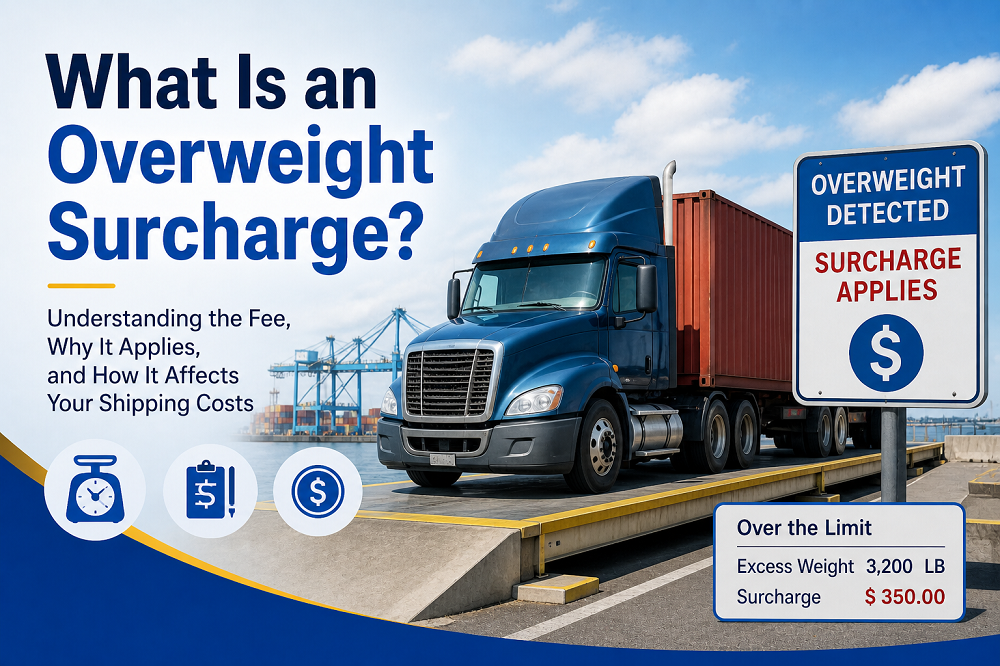
An Overweight Surcharge is an additional fee charged in international shipping when cargo exceeds the standard weight limits allowed for transportation equipment, road regulations, port handling, or carrier policies.
In global logistics, overweight charges are commonly applied to:
Ocean freight containers
Air cargo shipments
Truck transportation
Rail transport
For importers and exporters, especially those shipping heavy machinery, industrial materials, or dense cargo from China to overseas markets, understanding overweight surcharges is important for accurate freight budgeting and shipment planning.
Transportation infrastructure has strict weight limitations for safety and operational reasons. Excessively heavy cargo can:
Damage roads and port equipment
Increase fuel consumption
Create safety risks during handling
Slow down loading and unloading operations
Require special permits or equipment
To compensate for these additional operational costs and risks, carriers apply overweight surcharges.
An overweight surcharge may apply when:
The cargo weight exceeds carrier limits
The total container gross weight surpasses road restrictions
Port terminals require special handling
Inland trucking regulations are exceeded
Air cargo exceeds aircraft weight thresholds
The exact limits vary depending on:
Country regulations
Shipping route
Container type
Transportation mode
Carrier policy
In container shipping, overweight surcharges are most common for:
20GP containers carrying dense cargo
Heavy industrial equipment
Metal products
Stone materials
Machinery parts
For example, some U.S. trucking regulations may restrict container gross weight to around:
38,000–44,000 lbs for certain inland deliveries
If the shipment exceeds the permitted trucking weight after port arrival, additional fees or special arrangements may be required.
The surcharge may be calculated based on:
Excess weight amount
Weight brackets
Per container
Per kilogram or ton
Transportation distance
Examples include:
Fixed fee for containers over a certain weight
Incremental charges for every additional ton
Separate overweight trucking fees
The actual cost depends heavily on the destination country and inland transportation requirements.
In air cargo, overweight shipments may:
Require special loading equipment
Reduce aircraft loading efficiency
Need customized palletization
Airlines may apply overweight surcharges when cargo exceeds standard pallet or piece weight limitations.
Heavy cargo may also be subject to:
Special handling fees
Oversized cargo fees
Charter service requirements
To minimize overweight surcharges, shippers can:
Distribute cargo weight more evenly
Use multiple containers instead of one overloaded container
Verify gross cargo weight before booking
Check destination trucking regulations in advance
Select appropriate container types
Work with experienced freight forwarders
Proper cargo planning can help avoid unexpected logistics costs and delivery delays.
These two logistics terms are different:
| Term | Meaning |
Overweight Cargo | Cargo exceeds weight limitations |
Oversize Cargo | Cargo exceeds dimensional limits |
Some shipments may be both overweight and oversized, resulting in multiple surcharges.
Understanding overweight surcharges helps importers and exporters:
Estimate total shipping costs accurately
Prevent customs or delivery delays
Improve container loading efficiency
Avoid carrier penalties
Ensure compliance with transportation regulations
For businesses shipping heavy products internationally, overweight planning is a critical part of supply chain management.
The fee is triggered when cargo exceeds transportation or carrier weight limits.
No. Weight restrictions vary by country, carrier, transportation mode, and route.
Yes. Ports, terminals, or trucking companies may refuse overweight containers if they violate local regulations.
Yes. Heavy cargo often increases fuel, handling, equipment, and compliance costs.
Yes. Inland trucking companies may apply additional fees if the container exceeds local road weight limits.
Proper cargo distribution, advance planning, and selecting suitable container solutions can help reduce extra charges.
 2025 Amazon FBA rejects easy to melt goods how to do?April 7, 2025Urgent! Amazon US FBA new rules: easy to melt goods are marked “can not be delivered”? China Freight Forwarder Exclusive Solutionview
_400x400.webp) Trump's 'explosive' global tariffs take effect - including a 104% rate on ChinaApril 9, 2025New tariffs won't apply to goods already heading to US - expertDonald Trump's latest tariffs have come into effect - but what do they mean for international trade? The president of global logi...view
Trump's 'explosive' global tariffs take effect - including a 104% rate on ChinaApril 9, 2025New tariffs won't apply to goods already heading to US - expertDonald Trump's latest tariffs have come into effect - but what do they mean for international trade? The president of global logi...view What is Full Truck Load (FTL)September 1, 2025What Is Full Truck Load (FTL)?Full Truck Load (FTL) is a freight shipping service where an entire truck is reserved for a single customer’s cargo. Unlike Less-than-Truckload (LTL), where shipments fr...view
 What Is a Freight Hauler?November 24, 2025A freight hauler is a company or individual responsible for transporting goods from one location to another using commercial vehicles such as trucks, trains, ships, or aircraft. In simple terms, a fre...view
 English
  português
  Call us on:
  Email Us:
  International Mayors Exchange Center, No. 55 Shizhou Middle Rd, Nanshan District, Shenzhen Guangdong China
