


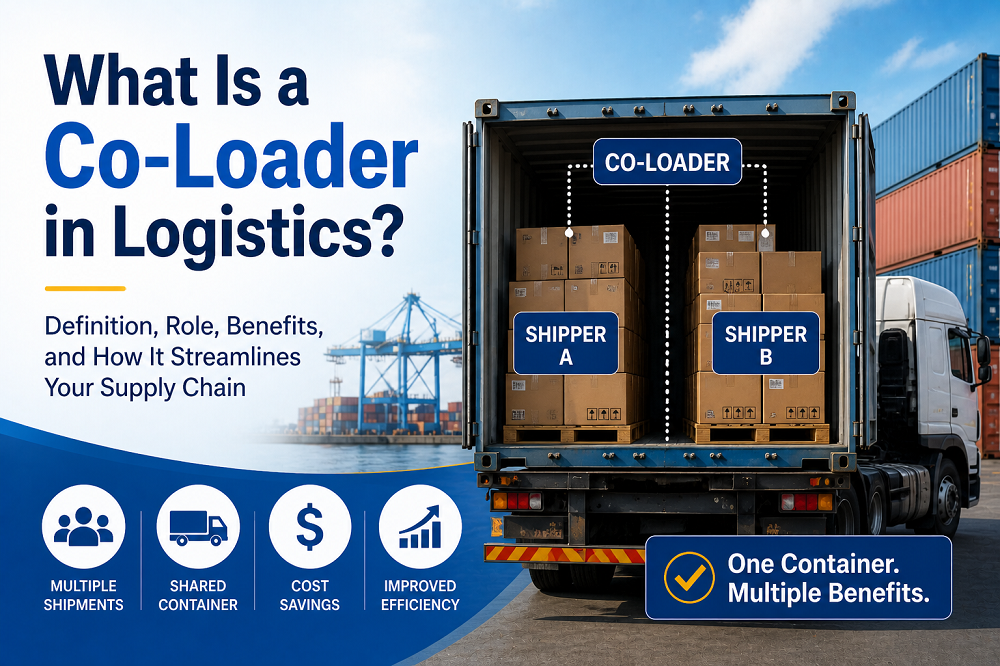
A co-loader is a logistics company or freight intermediary that consolidates cargo from multiple freight forwarders and books transportation space with carriers on their behalf.
In international shipping, co-loaders play an important role in:
Air freight consolidation
LCL ocean freight consolidation
Cargo space management
International forwarding networks
Rather than working directly with shipping lines or airlines for every shipment, smaller freight forwarders often use co-loaders to access better freight rates, stable space allocations, and global transportation networks.
A co-loader combines shipments from multiple forwarders into one larger consolidated shipment.
The process typically works like this:
Multiple freight forwarders collect cargo from their customers
The co-loader consolidates these shipments
The co-loader books cargo space with the airline or shipping carrier
The consolidated shipment moves under one master booking
Cargo is separated again at the destination
This model helps improve transportation efficiency and reduce shipping costs.
Although both operate in the logistics industry, their roles are different.
| Role | Main Function |
Freight Forwarder | Serves cargo owners directly |
Co-Loader | Serves other freight forwarders |
A freight forwarder manages customer shipments, while a co-loader provides consolidation and carrier booking support behind the scenes.
In many cases, the end customer may never know a co-loader is involved.
Many small or mid-sized freight forwarders do not have enough cargo volume to:
Secure competitive carrier contracts
Obtain guaranteed space allocations
Operate their own consolidation services
By working with co-loaders, they can:
Access lower freight rates
Reduce operational costs
Improve route coverage
Secure cargo space during peak seasons
Offer international services more efficiently
Co-loaders are especially common in air freight logistics.
Air freight co-loaders often:
Purchase bulk cargo space from airlines
Consolidate shipments from multiple agents
Repackage cargo under one master airway bill
Handle airport cargo coordination
This allows smaller forwarders to remain competitive in global air cargo markets.
In ocean shipping, co-loaders are commonly involved in:
LCL consolidation
NVOCC operations
Multi-origin cargo consolidation
For example:
Several freight forwarders may each have small cargo volumes
A co-loader consolidates them into one shared container
The container is shipped internationally as one booking
This helps reduce shipping costs for smaller shipments.
These two logistics terms are related but not identical.
| Term | Description |
Co-Loader | Consolidates cargo for other forwarders |
NVOCC | Operates as a carrier without owning vessels |
Some co-loaders also operate as NVOCCs, especially in ocean freight.
However, not all co-loaders issue their own house bills of lading or function as carriers.
Working with a co-loader offers several benefits:
Better freight pricing
Improved cargo consolidation
Access to global routes
More flexible shipping options
Reduced operational investment
Stronger carrier relationships
This is particularly useful for smaller logistics companies handling limited shipment volumes.
While co-loading improves efficiency, it may also introduce:
Additional handling steps
Longer transit times for consolidation
Communication complexity
Dependency on third-party operations
Choosing experienced and reliable co-loaders is important for maintaining service quality.
The co-loader system helps improve overall supply chain efficiency by:
Maximizing cargo space utilization
Reducing transportation costs
Supporting smaller freight forwarders
Improving global logistics connectivity
Without co-loaders, many smaller logistics providers would struggle to compete in international shipping markets.
A co-loader consolidates cargo from multiple freight forwarders and books transportation space with carriers.
No. A freight forwarder serves cargo owners directly, while a co-loader mainly serves other freight forwarders.
Yes. Co-loaders are widely used in international air cargo consolidation.
Some co-loaders can issue house bills of lading or airway bills, depending on their operating model.
Because co-loaders help them access better freight rates, cargo space, and international shipping networks.
Usually no. Most co-loaders arrange transportation through airlines, shipping lines, or NVOCC partnerships.
 What Are Warehousing Services?October 30, 2025Warehousing services refer to the storage, management, and handling of goods in a designated facility before they are distributed or shipped to their final destination. These services are a crucial pa...view
 Door to Door vs. Port to Port in International ShippingJune 16, 2024In the realm of international shipping, choosing the right logistics strategy can significantly impact the efficiency, cost-effectiveness, and overall success of transporting goods across borders. Two...view
 US-China Tariff Adjustments Drive Surge in US-Bound Ocean Freight from Shenzhen Yantian PortJune 3, 2025Following recent adjustments to US-China tariff policies, American buyers are accelerating their inventory stocking, leading to a significant increase in demand for US-bound ocean shipping. A represen...view
 What Is a Pallet Exchange Fee?May 6, 2026A Pallet Exchange Fee is a logistics charge applied when shipping pallets are not returned, exchanged, or transferred according to an agreed pallet exchange program between shippers, carriers, warehou...view
 English
  português
  Call us on:
  Email Us:
  International Mayors Exchange Center, No. 55 Shizhou Middle Rd, Nanshan District, Shenzhen Guangdong China
