


.webp)
A Power of Attorney (POA) is a legal document that authorizes one person or organization (the agent or attorney-in-fact) to act on behalf of another person or company (the principal) in specific legal, financial, or business matters.
In international shipping and customs, a POA is commonly used to authorize a customs broker or freight forwarder to handle customs clearance, file import or export documents, and communicate with customs authorities on behalf of the importer or exporter.
International shipments involve numerous legal and customs procedures. A POA allows a trusted representative to perform these tasks without requiring the importer or exporter to appear in person.
A POA enables an authorized party to:
File customs declarations
Pay duties and taxes
Submit import or export documentation
Respond to customs inquiries
Arrange customs inspections
Obtain cargo release from customs
Represent the importer during customs audits
Without a valid POA, customs brokers generally cannot legally act on behalf of an importer.
The process is straightforward:
The importer or exporter signs a Power of Attorney.
The document authorizes a customs broker or freight forwarder to act on their behalf.
The broker uses the POA to submit customs entries and communicate with customs authorities.
The authorization remains valid until it expires or is revoked.
For example, if a U.S. company imports machinery from China, it may authorize its customs broker through a POA to file customs entries with U.S. Customs and Border Protection (CBP), calculate duties, and arrange cargo release.
A typical Power of Attorney contains:
Name and address of the importer or exporter
Name and address of the authorized agent
Scope of authority granted
Effective date
Expiration date (if applicable)
Company registration information
Signature of the authorized company representative
Company seal (where required)
Some countries also require notarization or additional verification.
Grants broad authority to handle multiple customs and shipping transactions over an extended period.
Suitable for businesses that import or export regularly.
Authorizes the agent to handle only:
One shipment
One customs declaration
One specific transaction
After the transaction is completed, the authorization ends.
The most common type in international logistics.
It authorizes a licensed customs broker to:
File customs entries
Submit required government forms
Pay duties and taxes
Communicate with customs agencies
Resolve customs issues
A Power of Attorney is commonly required for:
Import customs clearance
Export customs declarations
Filing customs entries
Duty drawback claims
Customs audits
Government agency inspections
Import licensing procedures
For example, many customs brokers in the United States require a signed POA before filing import entries through CBP.
Although they are sometimes confused, these documents are different.
| Power of Attorney (POA) | Letter of Authorization (LOA) |
|---|---|
| Legal document | Administrative authorization |
| Grants legal authority | Grants limited permission |
| Often required by customs | Used for routine business activities |
| May remain valid for years | Usually applies to a single task |
A POA generally carries stronger legal authority than a standard authorization letter.
Authorized brokers can submit customs documents immediately without waiting for additional approvals.
Experienced customs professionals ensure documentation complies with local regulations.
Importers can focus on their business while brokers manage customs procedures.
Professional handling helps reduce documentation errors that may lead to customs inspections or shipment holds.
Yes. Depending on local regulations, a freight forwarder may receive a POA to:
Coordinate customs clearance
Arrange inland transportation
Collect shipping documents
Manage cargo release
Represent the customer during customs procedures
However, in many countries, only licensed customs brokers may perform certain customs-related activities under a POA.
Yes.
A Power of Attorney can usually be revoked at any time by the principal, provided:
Written notice is given to the authorized agent.
Any applicable customs authority is notified if required.
All affected parties are informed of the revocation.
Businesses should also update any customs brokers or logistics providers when changing representatives.
When issuing a Power of Attorney:
Clearly define the scope of authority.
Verify that the customs broker or freight forwarder is properly licensed.
Review the POA periodically to ensure it remains accurate.
Keep signed copies for your compliance records.
Revoke outdated authorizations promptly when changing service providers.
A Power of Attorney (POA) is a fundamental legal document in international shipping that authorizes a customs broker, freight forwarder, or other representative to act on behalf of an importer or exporter. It streamlines customs procedures, ensures regulatory compliance, and allows shipments to move through customs more efficiently.
For businesses importing from China, granting a POA to a trusted logistics partner can significantly simplify customs clearance, reduce administrative burdens, and help avoid costly delays during the import process.
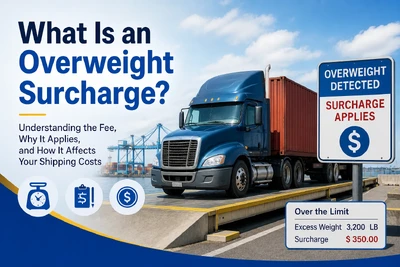 What Is an Overweight Surcharge?May 6, 2026An Overweight Surcharge is an additional fee charged in international shipping when cargo exceeds the standard weight limits allowed for transportation equipment, road regulations, port handling, or c...view
 The Rise of E-Commerce: Impact on China to USA Courier ServiceApril 9, 2025With the popularization of the Internet and the rapid development of science and technology, e-commerce is booming in the world. As an important player in e-commerce, China's rise has not only cha...view
 What is LCL Shipping? A Complete GuideApril 21, 2024Introduction to LCL ShippingLCL (Less than Container Load) shipping is a popular method for transporting smaller quantities of goods that do not fill an entire shipping container. It provides a cost-e...view
 Trump Doubles Tariffs: 50% on Steel and Aluminum Imports Starting June 4th!June 10, 2025Washington D.C. – June 3rd, 2025 – In a move set to impact global trade and china shipping, the White House announced today that President Trump has doubled tariffs on imported steel and aluminum, a...view
 English
  português
  Call us on:
  Email Us:
  International Mayors Exchange Center, No. 55 Shizhou Middle Rd, Nanshan District, Shenzhen Guangdong China
